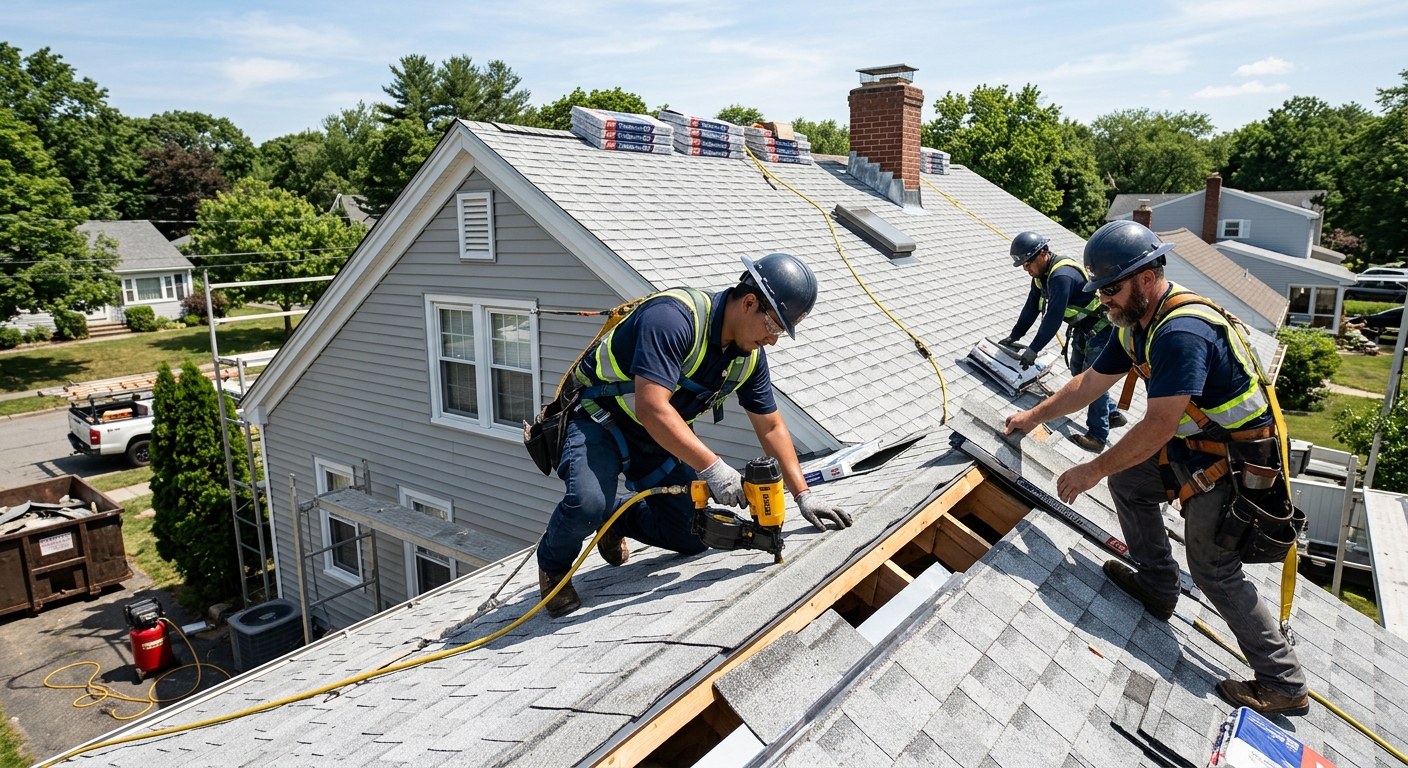
Roofing options and costs in Tweed
Tweed, Ontario homeowners are often dealing with roofs that have already seen decades of weather, especially in the town’s older housing stock: 61.2% of local homes were built before 1981, and 82.6% of households are owner-occupied (Statistics Canada, 2021 Census). That usually means more tear-offs, more decking surprises, and a higher chance a “simple replacement” turns into a repair-heavy job once the shingles come off. In neighbourhoods and rural pockets around Stoco Lake, where many single-detached homes dominate the streetscape, roof age and exposure can vary a lot from one property to the next, so quotes are rarely identical.
In the Kingston–Pembroke market, roofing prices are shaped by cold-climate labour realities: snow load, repeated freeze-thaw cycles, and the need for proper ice-dam protection at eaves and valleys. Contractors here often specify upgraded membrane coverage and more careful attic venting than you might see in milder parts of Ontario, and that extra attention adds material and labour cost. Shorter practical install seasons also matter; once summer demand hits, good crews are booked quickly and safety setups on steep or icy roofs slow production. For Tweed homeowners, that means the same roof can cost less in a shoulder-season repair window and more during a busy midsummer replacement cycle. The table below gives a realistic starting point for comparing options before you start calling for quotes.
| Type |
Typical Use |
Lifespan |
Best For |
Price Range |
| Full asphalt shingle replacement (tear-off + new install) |
Standard steep-slope homes needing a complete reset |
15–25 years |
Older Tweed homes with end-of-life shingles or multiple leaks |
$6,500–$15,000 |
| Architectural / laminated shingle (premium asphalt) |
Upgraded asphalt system for better curb appeal and durability |
20–30 years |
Homeowners wanting stronger wind performance and a better look |
$8,500–$18,500 |
| Impact-resistant shingle (Class 4 — hail & wind zones) |
Higher-durability asphalt for severe weather exposure |
25–35 years |
Properties with more wind exposure or insurance-driven upgrades |
$9,500–$21,000 |
| Metal roofing (steel panels or standing seam) |
Long-life residential roofing with strong snow-shedding |
40–50+ years |
Rural properties, higher-end homes, and low-maintenance buyers |
$18,000–$40,000 |
| Flat / low-slope membrane (TPO or EPDM) |
Porches, additions, garages, and low-slope sections |
15–30 years |
Homes with flat roof sections needing reliable watertight coverage |
$9,000–$25,000 |
| Roof repair + flashing only (no full replacement) |
Targeted leak repair, vent work, and flashing fixes |
Temporary to medium-term |
Localized leaks, storm damage, or serviceable roofs with one failure point |
$350–$2,500 |
Prices are estimates only and vary by project scope, site access and material selection.
What affects the price of roofing in Tweed
Quotes for the same roof can vary by 30%–50% across Kingston–Pembroke and broader Ontario because contractors are not pricing only shingles; they are pricing risk, access, labour time, disposal, and the amount of hidden work they expect to find once the tear-off begins. In Tweed, a straightforward asphalt replacement might land near the lower end of the $6,500–$15,000 band, but a house with a steep pitch, two layers to remove, rotten decking, and several flashing transitions can quickly move toward the higher end. Snow load and freeze-thaw cycling across Ontario and Alberta push crews to install heavier ice-and-water protection and more robust underlayments, while Alberta’s hail belt drives demand for impact-rated shingles. Coastal BC’s rain and wind exposure, by contrast, often makes metal roofing and premium synthetic underlayment more attractive. In colder regions, shorter install seasons concentrate demand into a few good months, which can push labour rates up and reduce contractor availability exactly when homeowners want the work done.
In Tweed specifically, older homes built before 1981 are more likely to hide deck repairs under the shingles, so a job that started as a simple replacement can pick up an extra $500–$2,500 in plywood or OSB work. A basic repair plus flashing visit may come in around the lower end of the $350–$2,500 range, but chimney flashing, skylight rework, or valley repairs can push that upward fast. By contrast, a smaller rural bungalow with easy driveway access and one shingle layer may stay economical even if the roof is moderately large. Material tier matters too: standard architectural shingles usually cost less upfront than impact-rated systems, but the upgrade can pay off on exposed sites where wind and snow shedding are concerns.
| Price Factor |
Why It Matters |
Cost Impact |
| Roof pitch and steepness |
Affects safety equipment and install speed |
Steeper roofs often add $500–$2,000 |
| Number of shingle layers to tear off |
2 layers = extra labour + disposal |
May add $800–$2,500 |
| Total roof area in squares (1 square = 100 sq ft) |
More surface area means more material and labour |
Larger roofs can move a job from $6,500–$15,000 toward $15,000–$25,000 |
| Decking condition |
Rotted OSB or plywood must be replaced |
Commonly adds $500–$2,500 |
| Chimney, skylight and vent flashing complexity |
More penetrations mean more labour and leak risk |
Can add $200–$1,500 |
| Ice-and-water shield coverage required (climate-driven) |
Cold-climate protection at eaves and valleys costs more |
Often adds $150–$800 |
| Regional labour rates and length of the install season |
Shorter seasons and peak-demand booking raise pricing |
Can shift totals by 10%–20% |
| Material quality tier (standard vs. impact-rated vs. premium) |
Better shingles and underlayments cost more upfront |
Usually adds 15%–30% |
Permits & regulations in Ontario
In Ontario, most like-for-like re-roofing jobs do not require a building permit, which means replacing worn shingles with a similar roofing system on the same roof structure is usually straightforward. However, a permit is commonly needed if the work changes the building structure, such as replacing damaged rafters or sheathing in a way that affects the roof assembly, converting a pitched roof to a flat roof, or adding new dormers or other structural changes. If a contractor is installing a second roof layer beyond what local code allows, that should also be treated as a red flag and may trigger code issues even if a formal permit is not always obvious to the homeowner. Repairing flashing, replacing shingles, and doing routine leak repairs typically do not require a permit.
Before signing, ask for proof of liability insurance, WSIB coverage, and manufacturer certification if the install is supposed to qualify for a product warranty. Check the contractor’s business name and public profile online, then ask for a certificate of insurance that shows active general liability coverage and the policy limits. For worker coverage, request a WSIB clearance letter and verify it is current; reputable contractors can produce it quickly. If the contractor claims to be incorporated or licensed for other trades, confirm the legal business name matches the insurance documents and invoice. In Tweed and across Ontario, a homeowner should not rely on a verbal assurance alone. Get the documents in writing, compare the names carefully, and make sure the contract scope matches what the paperwork says they are insured to do. That extra step protects you if there is a fall, a site injury, or a warranty dispute later.
Choosing the right roofing material for Tweed's climate
Tweed’s freeze-thaw cycles, winter snow load, and spring shoulder-season moisture should drive roofing choices more than sales pitch alone. Standard architectural shingles are usually enough for many homes in town, especially if the attic is well ventilated and the roof pitch sheds snow properly. They offer a good balance of cost and performance, and for many homeowners in the Kingston–Pembroke market they are the most practical fit. Impact-resistant shingles can make sense when the roof is exposed, the property sits on open land, or the homeowner wants better wind and impact performance; the premium is often 20%–30% over standard asphalt, but that extra spend can be reasonable if it avoids early replacement or supports an insurance preference. For example, if a standard roof comes in at $9,000–$12,000, an impact-rated version might be $11,000–$15,500; on a wind-exposed rural property, that difference can be justified, while on a sheltered in-town bungalow it may not pay back as clearly.
Metal roofing makes long-term financial sense when the homeowner plans to stay put, wants low maintenance, or is replacing a roof with a history of ice-dam trouble. Standing seam performs best and adds resale appeal, but the cost is much higher upfront, so it is most sensible on higher-value homes or when a roof is hard to access for future repairs. Flat TPO or EPDM is the right answer for low-slope sections, additions, and porches where shingle systems are not appropriate. Ontario insurers and some carriers may offer premium differences for impact-resistant or wind-rated products in certain cases, but the real value is often in durability and reduced maintenance rather than a guaranteed rebate. In Tweed, the best choice is usually the system that matches the roof shape, the snow load, and how long you plan to own the home.
| Material |
Lifespan |
Snow & Ice Performance |
Wind / Hail |
Maintenance |
Price Band |
| Asphalt 3-tab (entry-level) |
12–18 years |
Basic performance; more vulnerable to ice-dam stress |
Moderate wind resistance; limited hail tolerance |
Higher maintenance, especially on older homes |
$6,500–$10,000 |
| Asphalt architectural / laminated (standard) |
20–30 years |
Good all-around choice with proper ice-and-water shield |
Better wind resistance than 3-tab |
Moderate maintenance |
$8,500–$18,500 |
| Impact-resistant shingle (Class 4) |
25–35 years |
Strong when paired with good ventilation and eave protection |
Best asphalt option for wind and impact resistance |
Lower repair frequency, higher upfront cost |
$9,500–$21,000 |
| Metal — steel panels (exposed fastener) |
30–45 years |
Excellent snow-shedding; good for icy winters |
Very good wind performance; moderate hail resistance |
Low to moderate maintenance |
$18,000–$30,000 |
| Metal — standing seam (concealed fastener) |
40–50+ years |
Excellent in snow and ice when detailed properly |
Top-tier wind performance; strong long-term value |
Low maintenance |
$24,000–$40,000 |
| Flat TPO / EPDM membrane (low-slope only) |
15–30 years |
Good on properly sloped low-slope roofs; sensitive to ponding if poorly designed |
Solid wind resistance when mechanically fastened or fully adhered |
Moderate maintenance and inspection |
$9,000–$25,000 |
How to choose a roofing contractor in Tweed
Start with verification, not price. In Ontario, ask each contractor for their legal business name, liability insurance certificate, and WSIB clearance letter before you accept a quote. A good contractor will also show manufacturer training or certification for the roofing system they are proposing, especially if the warranty depends on that credential. Then get at least 2 to 3 itemised written quotes so you can compare labour, materials, tear-off, ice-and-water shield, flashing, disposal, and cleanup separately rather than guessing what is included in a lump sum. Read the scope line by line: does it include permit pulls if needed, replacement of damaged decking, drip edge, ventilation upgrades, and magnet sweep cleanup? Ask who is responsible for hidden rot if it is discovered after tear-off.
Warranty matters just as much as price. You want both a workmanship warranty and a product warranty in writing, with clear terms on whether either one is transferable to a future buyer. Payment terms should be reasonable: never hand over more than 10%–15% upfront, and hold back the balance until the job is completed, inspected, and cleaned up. Get the start date and estimated completion date in writing, because weather delays are common in Tweed and across the Kingston–Pembroke region. If a contractor refuses paperwork, is vague about insurance, or pushes for a big deposit, keep shopping. Good roofers are used to homeowners asking detailed questions.
- Confirm the contractor’s legal business name matches the quote and insurance documents.
- Ask for a current certificate of liability insurance.
- Request a WSIB clearance letter and check that it is active.
- Get 2 to 3 itemised quotes, not just one lump-sum number.
- Compare tear-off, disposal, underlayment, flashing, and ventilation line items.
- Ask exactly how many ice-and-water shield rows are included.
- Check whether permit work is included if the job requires one.
- Confirm the workmanship warranty length in writing.
- Ask whether the manufacturer warranty is transferable.
- Keep the deposit to 10%–15% maximum.
- Get a written start date and completion estimate.
- Ask how the crew handles hidden rot or extra decking replacement.
Red flags in Tweed include a contractor who will not show WSIB coverage, insists on cash only, quotes far below the local $6,500–$15,000 asphalt replacement band without a clear reason, refuses to itemise disposal or flashing, or says a permit is “never needed” for any roof work. Be careful with anyone who pressures you to sign on the spot after a drive-by inspection.
Frequently asked questions — roofing in Tweed
Should I repair or replace my roof in Tweed?
If the leak is isolated and the shingles are otherwise in decent shape, a repair may be the right first step in Tweed. A targeted fix with flashing work can often stay in the $350–$2,500 range, which makes sense for a chimney leak, a vent boot failure, or a small valley issue. But if your roof is nearing the end of its life, has multiple patches, curled shingles, or two layers already in place, replacement usually becomes the better long-term move. Older homes in Ontario, especially ones built before 1981, often hide decking damage that turns repeat repairs into a costly cycle. If the roof is leaking in several places or the shingles are brittle in cold weather, replacing the system can save money over the next few seasons.
What is ice and water shield and do I need it in Ontario?
Ice and water shield is a self-sealing membrane installed at eaves, valleys, and other vulnerable areas to help block wind-driven water and ice backup. In Tweed and the broader Ontario climate, it is not optional in practical terms on many roofs, especially where snow load and freeze-thaw cycles are common. Good roofers in the Kingston–Pembroke region use it to reduce ice-dam risk around the lower roof edge and in valleys. The extra material cost is small compared with the cost of repairing a winter leak, so it often belongs in the budget from day one. On an asphalt replacement, that protection can be part of the difference between a low bid and a more durable roof built for local winters.
How do I spot a low-quality roofing bid in Tweed?
A low-quality bid often looks cheap because it leaves out the expensive parts. In Tweed, watch for quotes that do not mention tear-off layers, flashing, disposal, ventilation, or ice-and-water shield. If a bid comes in well below the typical $6,500–$15,000 asphalt replacement range without explanation, ask what was excluded. Another warning sign is a contractor who offers only a verbal quote, will not show insurance, or refuses to specify shingle brand and warranty length. A proper bid should tell you whether permit work is included, whether deck repairs are extra, and how many penetrations are being flashed. If the answer is vague, the job probably is too.
What roofing upgrades add the most resale value in Tweed?
For most Tweed homes, the biggest resale-value upgrades are not flashy extras; they are durable, well-detailed roofing systems that signal low future maintenance to buyers. Architectural shingles usually add more value than entry-level 3-tab because they look better and perform better in Ontario weather. If the house is exposed or the buyer pool values low maintenance, metal roofing can also be a strong selling feature, though the upfront cost is much higher at $18,000–$40,000. On older homes, replacing failing flashing, improving ventilation, and using proper ice-and-water shield often matter as much as the visible shingles. Buyers in the Kingston–Pembroke market tend to notice whether the roof looks new, clean, and properly detailed.
Can a roofing contractor work year-round in Tweed?
Some roofing work can happen year-round in Tweed, but not every project is suitable for every season. Emergency repairs, flashing fixes, and some low-slope membrane work can be done in colder months if conditions are safe. Full shingle replacements are more weather-sensitive because adhesive strips, deck conditions, and installation temperatures matter. In winter, snow, ice, and shorter daylight hours slow production and can affect price and scheduling. That is one reason good crews often book heavily in the summer and shoulder seasons. If you are planning a full asphalt replacement, it is usually easier to schedule when temperatures are moderate and the roof deck is dry.
What is a roofing square and how does it affect my quote?
A roofing square is a standard measurement equal to 100 square feet of roof area. Contractors use it to estimate materials, labour, and waste. If your roof is 24 squares, that means roughly 2,400 square feet of roofing surface before waste and complexity are added. The larger the square count, the more shingle bundles, underlayment, ice-and-water shield, and labour are required. In Tweed, a larger roof can move an asphalt job from the lower end of the $6,500–$15,000 band toward the upper end or beyond if the pitch is steep or tear-off is complicated. Understanding squares helps you compare quotes fairly because a contractor pricing 18 squares is not bidding the same job as one pricing 26 squares.