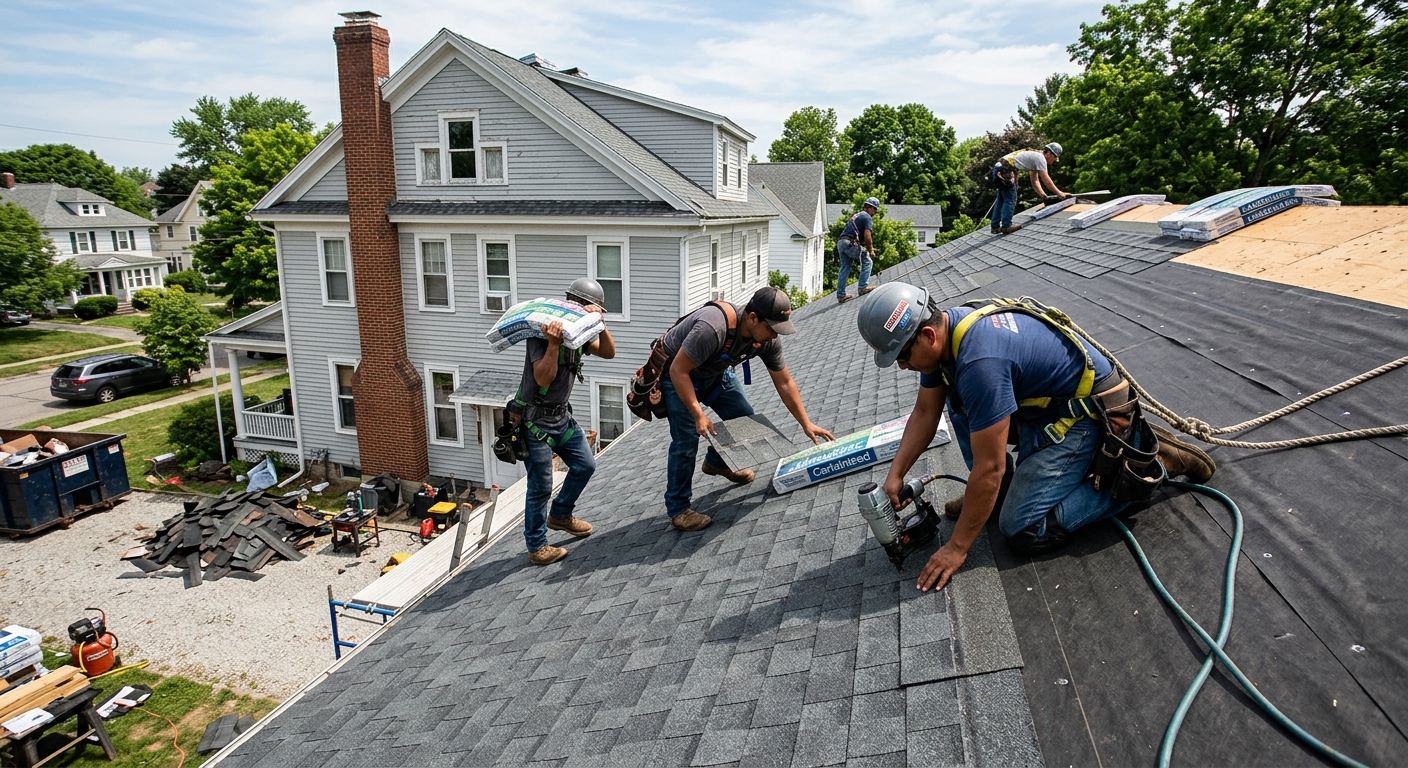
Roofing options and costs in West End
West End, British Columbia homeowners usually face roofing decisions shaped by coastal rain, wind, and a housing stock that still includes many older strata and rental buildings. With a population of 47,200 (Statistics Canada, 2021 Census), this neighbourhood has a dense mix of low-rise walk-ups, heritage-era houses, and mid-century buildings, so roof age and access conditions vary a lot from one block to the next. In practical terms, that means more jobs where the roof is simply at end of life, and more projects that need careful tear-off planning, balcony protection, and tight scheduling around residents. Around the Denman and Davie corridor, reroofing demand is especially steady because many buildings are exposed to salt-laden rain and wind off English Bay. In Lower Mainland–Southwest BC, pricing is shaped less by snow load than by waterproofing quality, flashing detail, and year-round labour demand. Compared with Ontario or Alberta, you usually see fewer ice-dam upgrades built into the base quote, but better underlayment and more robust edge details are common because sustained rain and storm gusts punish weak installs. Material choices also matter more in exposed coastal locations: metal and premium synthetics cost more upfront, but they perform well when wind-driven rain finds every seam. For most homeowners, the first step is comparing the roof type, the access challenges, and the likely replacement scope against the local price bands below.
| Type |
Typical Use |
Lifespan |
Best For |
Price Range |
| Full asphalt shingle replacement (tear-off + new install) |
Standard sloped roofs on detached homes and low-rise buildings |
15–25 years |
Budget-conscious owners needing a full refresh |
$8,000 – $18,000 |
| Architectural / laminated shingle (premium asphalt) |
Most pitched roofs where a better look and longer service life matter |
25–30 years |
Owners wanting better wind performance and curb appeal |
$10,500 – $22,000 |
| Impact-resistant shingle (Class 4 — hail & wind zones) |
Homes seeking extra impact resistance and stronger warranties |
25–35 years |
Higher-exposure sites and owners prioritizing durability |
$12,500 – $25,000 |
| Metal roofing (steel panels or standing seam) |
Long-life sloped roofs, modern homes, and exposed coastal sites |
40–60+ years |
Best long-term value where durability matters most |
$20,000 – $45,000 |
| Flat / low-slope membrane (TPO or EPDM) |
Flat roofs on laneway homes, multiplexes, and multi-family buildings |
20–30 years |
Low-slope roofs needing reliable waterproofing |
$9,000 – $25,000 |
| Roof repair + flashing only (no full replacement) |
Localized leaks, pipe boots, chimney flashing, and small repairs |
Varies by roof condition |
Short-term fixes when the roof is otherwise serviceable |
$500 – $8,000 |
Prices are estimates only and vary by project scope, site access and material selection.
What affects the price of roofing in West End
Two West End quotes for what looks like the same roof can easily differ by 30% to 50% across Lower Mainland–Southwest BC because contractors are pricing more than shingles or membrane. They are pricing access, weather risk, tear-off difficulty, disposal, and how much detail work the roof needs. On a dense street in West End, a job with limited staging space, shared lanes, or no easy material drop can cost more than a similar roof in a suburban area. A simple asphalt reroof might land near the lower end of the $8,000 – $18,000 band, while a more detailed architectural shingle job with multiple penetrations, rot repair, and upgraded underlayment can move quickly upward. Flat roofs often sit in the $9,000 – $25,000 range because membrane choice, substrate condition, and drainage details matter a lot. Across Ontario and Alberta, snow load and freeze-thaw cycles drive heavier ice-dam protection and more aggressive ventilation upgrades; Alberta’s hail belt also pushes demand for impact-rated shingles. In coastal BC, by contrast, rain and wind push contractors toward better waterproofing, premium synthetic underlayment, and metal on exposed sites. Shorter install seasons in colder provinces concentrate demand into summer, which can raise labour premiums, but West End’s year-round installability keeps scheduling more flexible. Still, in a busy urban market, labour is not cheap: a roof that needs extra harnessing, elevator coordination, or hand-bombing materials up tight access can add thousands. Older housing in the neighbourhood can also raise cost because rot repairs, outdated flashings, and 2-layer tear-offs are common enough to matter on the final invoice.
| Price Factor |
Why It Matters |
Cost Impact |
| Roof pitch and steepness |
Affects safety equipment, crew speed and fall protection needs |
Steeper roofs can add $500 – $3,000 or more |
| Number of shingle layers to tear off |
2 layers = extra labour + disposal |
Often adds $1,000 – $4,000 |
| Total roof area in squares (1 square = 100 sq ft) |
More area means more material, labour and waste |
Larger roofs can move a quote from $8,000 – $18,000 toward the upper end |
| Decking condition |
Rotted OSB or plywood must be replaced |
Usually $80 – $140 per sheet installed |
| Chimney, skylight and vent flashing complexity |
More penetrations mean more labour and leak risk |
Can add $300 – $2,500 |
| Ice-and-water shield coverage required |
Climate-driven waterproofing at eaves, valleys and vulnerable areas |
Often adds $250 – $1,500 |
| Regional labour rates and length of the install season |
Urban access and strong construction demand affect crew pricing |
Can shift total quotes by 10%–20% |
| Material quality tier (standard vs. impact-rated vs. premium) |
Better products cost more but usually last longer and resist wind better |
May add $1,500 – $8,000 depending on roof size |
Permits & regulations in British Columbia
In British Columbia, most like-for-like re-roofing does not require a building permit, but there are important exceptions. If you are replacing a pitched roof with a flat or low-slope system, making structural deck repairs, changing roof framing, or adding work that affects structural loads or drainage in a significant way, a permit may be required. A straightforward tear-off and re-shingle on the same roof shape typically does not trigger a permit, but adding a second layer where the code or local rules do not allow it can create problems later. Contractors should also carry liability insurance, WCB coverage, and manufacturer certification if they are offering warranty-backed installs. Before signing, ask for the contractor’s British Columbia business licence or company registration details, then verify them through the appropriate online registry. Next, request a current certificate of insurance showing dates, coverage limits, and named insured status. For WCB, ask for a clearance letter and confirm the account is active and in good standing; do not rely on a verbal promise. If the contractor subcontracts, make sure the same documents are available for the crew doing the actual work. For West End homeowners, this matters because dense urban sites can involve shared access, balconies, and adjacent properties, so you want a contractor who is properly covered before a ladder goes up. If something is vague, pause and get it in writing.
Choosing the right roofing material for West End's climate
West End roofing choices should reflect coastal rain, wind exposure, and the reality that most damage here comes from persistent moisture rather than heavy snow. Standard architectural shingles are usually sufficient for many low- to moderate-exposure homes, especially if the roof has good slope, proper ventilation, and quality flashing. They are a sensible middle ground for homeowners who want a decent look and a reasonable lifespan without jumping into the $20,000 – $45,000 metal range. Impact-resistant shingles make more sense when the home sits in a windier, more exposed pocket or when the owner wants extra insurance against debris impact and stronger product performance; the premium is often 20% to 30% over standard laminate, and that can be worth it if the roof is difficult to access or you plan to stay long term. Metal roofing is usually the best financial sense when durability, low maintenance, and resale value matter most, because the upfront cost is higher but the service life can be 40 years or more. For flat or low-slope roofs, TPO or EPDM is the right answer because shingles simply are not designed for that geometry. In British Columbia, some insurers may offer premium reductions for high-wind-rated or more durable systems, though the discount is not always large enough to justify an upgrade by itself. A practical example: if a standard laminate reroof is quoted at $14,500 and a metal option comes in at $28,000, metal only makes sense if you value the lower maintenance and longer life enough to offset the extra upfront cost over time. In a West End coastal environment, that calculation can absolutely pencil out on a long-term hold property.
| Material |
Lifespan |
Snow & Ice Performance |
Wind / Hail |
Maintenance |
Price Band |
| Asphalt 3-tab (entry-level) |
15–20 years |
Basic; needs good underlayment and ventilation |
Moderate wind resistance, weakest of the options listed |
Higher maintenance; more prone to curling and granule loss |
$8,000 – $12,500 |
| Asphalt architectural / laminated (standard) |
25–30 years |
Good for coastal BC when installed with proper edge protection |
Better wind performance than 3-tab |
Moderate maintenance |
$10,500 – $22,000 |
| Impact-resistant shingle (Class 4) |
25–35 years |
Good; often paired with upgraded underlayment |
Strong wind and improved impact resistance |
Moderate maintenance; usually better warranty options |
$12,500 – $25,000 |
| Metal — steel panels (exposed fastener) |
30–45 years |
Very good shedding and drainage |
Excellent wind resistance; good hail tolerance |
Low to moderate; fasteners should be checked periodically |
$20,000 – $34,000 |
| Metal — standing seam (concealed fastener) |
40–60+ years |
Excellent for heavy rain and coastal moisture |
Excellent wind performance; very strong overall |
Low; premium detailing and longer service life |
$28,000 – $45,000 |
| Flat TPO / EPDM membrane (low-slope only) |
20–30 years |
Excellent when drainage is designed correctly |
Good; depends on fastening and edge details |
Low to moderate; requires periodic inspection |
$9,000 – $25,000 |
How to choose a roofing contractor in West End
Start by checking that the contractor is properly set up for British Columbia work and can document it. Ask for the company’s legal name, business number, and local contact details, then verify the registration through the relevant online business registry. Request a certificate of insurance showing liability coverage, policy dates, and coverage limits; do not accept a blurry photo without the policy information. For WCB, ask for a clearance letter and confirm it directly with the insurer or through the WCB clearance process. Get 2 or 3 written quotes and insist on an itemised breakdown showing labour, materials, disposal, flashing, decking allowance, and any permit costs. Read the scope line by line: ask what is excluded, whether disposal is included, and whether the contractor will pull permits if needed. Warranty matters too: find out the workmanship warranty length, whether the product warranty is manufacturer-backed, and whether either one is transferable if you sell the home. Payment terms should be conservative: never pay more than 10% to 15% upfront, and keep a holdback until the job is complete and inspected. Also ask for the start date and estimated completion date in writing, because West End jobs can be delayed by weather, access, or building management rules.
- Verify British Columbia business registration before signing.
- Ask for a current certificate of insurance.
- Confirm WCB coverage and request a clearance letter.
- Get 2 to 3 itemised written quotes.
- Make sure labour and materials are separated.
- Check whether permit pulling is included.
- Confirm disposal and cleanup are included.
- Ask what flashing details are included at chimneys, skylights and vents.
- Ask for workmanship warranty length in writing.
- Confirm product warranty terms and transferability.
- Limit deposit to 10%–15%.
- Get a written start date and completion estimate.
Red flags in West End include a contractor who refuses to name the crew, won’t provide insurance papers, offers only a lump-sum quote, pushes for a large cash deposit, or avoids discussing permits, disposal, and flashing details. Another warning sign is a quote that is far below the local norm without any clear explanation.
Frequently asked questions — roofing in West End
Should I repair or replace my roof in West End?
If the damage is isolated, a repair is often the smart move in West End, British Columbia, especially when the rest of the roof is still within its expected service life. A localized leak around a chimney, vent, or skylight may fall into the $500 – $8,000 repair band, depending on how much flashing work and dry-out is involved. But if the roof is near the end of its life, has recurring leaks, or already has two layers, replacement usually makes more sense. Coastal rain can hide problems until they become expensive, so repeated patching on an old roof is often false economy.
What is ice and water shield and do I need it in British Columbia?
Ice and water shield is a self-adhering waterproof membrane installed at vulnerable roof areas such as eaves, valleys, and around penetrations. In British Columbia, including West End, you usually do not need the heavy ice-dam protection used in colder provinces to the same degree, because sustained snow and deep freeze conditions are less common. That said, you still benefit from membrane protection in our rain-heavy climate, especially where wind-driven water can get under shingles. On a reroof, adding proper membrane coverage can move a project slightly upward, but it is usually a wise investment compared with the cost of future leak repairs.
How do I spot a low-quality roofing bid in West End?
A low-quality bid in West End often looks attractive only because it leaves out important details. Watch for missing line items, vague scope language, no mention of flashing, and no allowance for disposal or decking repairs. If the quote is far below the local range — for example, a full roof replacement that should be around $8,000 – $18,000 but comes in suspiciously low — ask why. Poor bids also avoid stating workmanship warranty length, permit responsibility, or exact material brand and model. In a coastal climate, that omission can matter more than a few hundred dollars saved up front.
What roofing upgrades add the most resale value in West End?
In West End, the upgrades that tend to help resale most are the ones buyers can trust: clean flashing details, good ventilation, modern architectural shingles, or a well-done standing seam metal roof. A roof that looks sharp and has documented installation quality reduces buyer hesitation. For many homes, stepping up from a basic asphalt system to a better laminate product is enough. If the property is long-term hold or high-end, a metal roof may make sense because it signals durability and lower maintenance. The extra cost is real — often moving from the asphalt band into the $20,000 – $45,000 range — but that can pay back through stronger buyer confidence.
Can a roofing contractor work year-round in West End?
Yes. Unlike colder parts of Canada, West End and much of British Columbia allow roofing work through most of the year because we do not have the same long winter shutdowns. That said, rain and wind can still interrupt work, and careful contractors will reschedule during unsafe conditions. Year-round installability is one reason labour pricing is more predictable here than in provinces with short roofing seasons. It also means you can often avoid the summer backlog if you book early. For flat roofs and membrane repairs, winter scheduling is common as long as conditions are safe and the substrate is dry enough for proper adhesion.
What is a roofing square and how does it affect my quote?
A roofing square is a unit of area equal to 100 square feet. Roofers use it to estimate materials, labour, waste, and installation time. A 20-square roof is roughly 2,000 square feet before waste and detailing. In West End, the number of squares matters because larger or more complex roofs quickly move a quote upward, especially when the roof also has steep slopes, skylights, or limited access. If one contractor is pricing by square and another is using a loose lump sum, the detailed bid is usually easier to compare. On a typical asphalt reroof, the square count is a major reason one quote sits near $8,000 – $18,000 while another lands much higher.